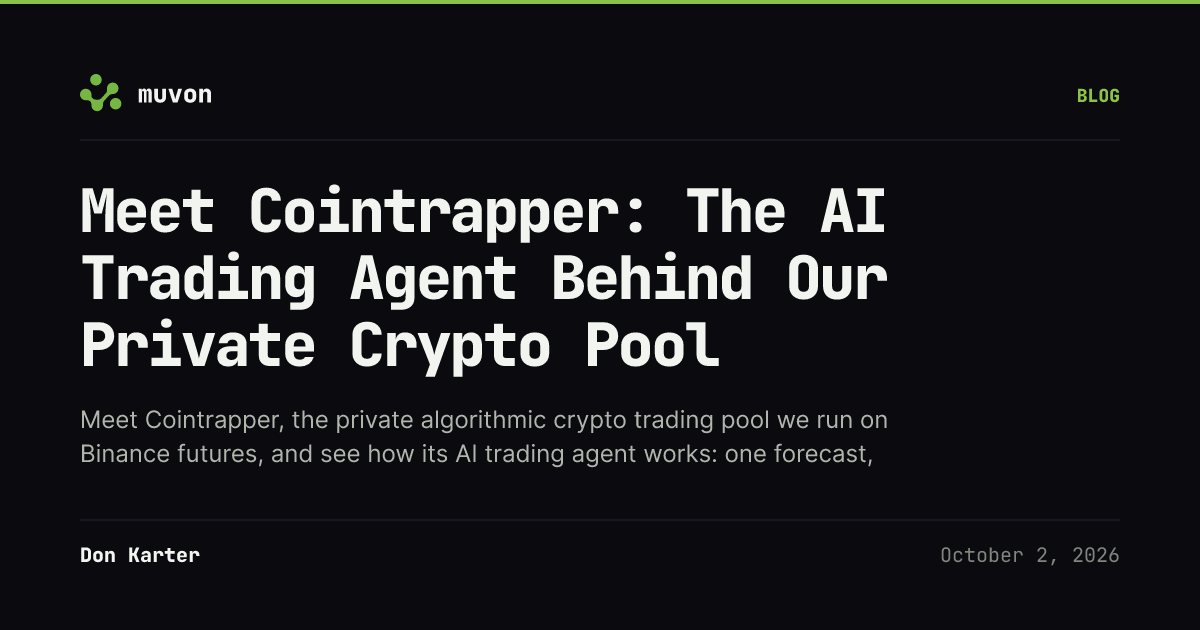
Meet Cointrapper: The AI Trading Agent Behind Our Private Crypto Pool
An AI trading agent can mean a chatbot that suggests a ticker, a fixed strategy with a new label, or software with permission to place orders. The useful question is what happens between the prediction and the order—and what the software is allowed to do when it gets there.
Cointrapper is a private algorithmic crypto trading pool on Binance futures, open by application. We run it — Muvon operates the service — and it runs on our own open-source stack. Participants never hand over exchange access or API keys; the algorithm trades on the pool’s own accounts.
What is an AI trading agent, and what is Cointrapper?
An AI trading agent takes market information, forms or receives a decision, and can act through tools. The label alone says little about its controls. Cointrapper’s AI crypto trading agent combines a market forecast, separate roles, and order tools for Binance futures. Splitting an LLM trading agent’s work into specialists isn’t our invention: the TradingAgents preprint (Xiao et al., 2024) models a trading firm as LLM agents in specialist roles — fundamental, sentiment and technical analysts, plus traders with different risk profiles. Cointrapper runs a smaller version of the same idea.
The pool’s accounting currency is USDT. Approved participants see a cabinet with their position, pool NAV, and history. Cointrapper’s site is not a public offer.
Broker products work differently: Robinhood Agents has you fund a separate account for your agent, with trade approvals on by default. Cointrapper is a shared pool that tracks each person’s share in units. Compare that structure before you compare agent features.
How does an AI trading agent turn a forecast into an order?
The workflow is a sequence of gates: forecast → analyst setup or skip → expected-value check → trader action → guard maintenance. A forecast is an input, not an order. The Model Context Protocol architecture (2026) gives the connection model in one sentence: an AI host connects through an MCP client to a server that provides context or tools. In Cointrapper, the agents that act on the exchange do it through a Binance MCP server; the agent that forms the opinion gets no tools at all.
- Forecast. Vanga, our open-source LSTM forecasting model, produces a market view. If its configured confidence threshold is not met, it produces no signal. A signal still has to pass the next stages.
- Analyst. The analyst reads that forecast plus a live market snapshot — price, recent candles, order book, funding — fetched server-side seconds before the run. It has no tools and no account access. It returns a three-level setup (entries, take-profits, stops) or a skip.
- Expected-value gate. The proposed ladder is replayed against that symbol’s own historical candles, including partial fills and fees. A setup whose replay measurably loses money is rejected. This gate rejects some candidates; it does not certify that an accepted setup will win. Where there are fewer than 30 historical fills, the system uses a risk/reward floor instead.
- Trader. Only after dispatch does the trader apply the setup to the live account. Its choices are open, add to an existing position (DCA), reverse, or skip.
- Guard. On a schedule, the guard manages protective orders and pending maker entries for open positions.
The Binance futures MCP server the trader and guard use is public; the Cointrapper backend that wires everything together is private.
Why split trading across three agents?
Separate roles let you say exactly which part forms the opinion, which part places orders, and which part looks after open positions. Every agent run is a bounded one-shot with a timeout, never a long-running session that keeps its own context alive.
| Role | What it sees | What it does | Its limit |
|---|---|---|---|
| Analyst | The Vanga forecast plus a live market snapshot fetched before the run | Proposes a three-level setup or skips | No tools at all: it cannot see or touch the account |
| Trader | A setup that passed the gate, plus the live account | Opens, adds to a position (DCA), reverses, or skips | Runs only when a setup is dispatched; one bounded run per setup |
| Guard | Open positions and their orders, on a schedule | Maintains stops, take-profits, and pending maker entries | Instructed never to open a new trade or close a position; one bounded run per check |
The hard boundary is the analyst — it forms the opinion and holds no tools. The trader and the guard both hold exchange tools; what keeps them apart is their instructions and when they run — the trader only on a setup that passed the gate, the guard only on its schedule. Ask any vendor for the same row-by-row table, and ask which limits are enforced by tools and which by instructions. For the broader principle of restricting what an agent can touch, see our guide to giving an AI agent a filesystem safely.
Which open-source parts sit underneath Cointrapper?
Four public projects cover distinct jobs in the stack.
- Vanga is a Rust forecasting project with five coordinated targets: price levels, direction, volatility, volume, and sentiment. Its own disclaimer limits it to research and education and says its outputs are not financial advice.
- Octomind is the open-source agent runtime. Each Cointrapper agent is an Octomind role with its own model, instructions, and tool list; our post on running one AI agent across many models shows how roles pick their models.
- Pulsora is the Rust time-series database that holds Cointrapper’s market data: Binance trades, funding events, and futures positioning, plus the frame metrics Vanga reads. Our post on Pulsora as a trading-data store explains why we built it.
- mcp-binance-futures is a Binance MCP server for futures trading.
Open source is useful for examining those components. It does not make the private trading backend or the pool itself open source, and a repository’s license is not evidence of trading quality.
How does a shared pool track each person’s share?
It uses NAV per unit. A deposit buys units at the unit price when the deposit is booked; the deposit changes ownership but must not change that price. A withdrawal burns units. No individual trade is allocated to one participant.
Here is a hypothetical calculation, with fees ignored:
| Step | Pool NAV | Units | NAV per unit | Participant position |
|---|---|---|---|---|
| Start | 10,000 USDT | 10,000 | 1.00 USDT | — |
| After a decline | 9,500 USDT | 10,000 | 0.95 USDT | Existing holder of 10,000 units: 9,500 USDT |
| New deposit booked | 10,500 USDT | 11,052.63 | 0.95 USDT | New 1,000 USDT deposit: 1,052.63 units |
The new units are 1,000 ÷ 0.95 = 1,052.631…, shown to two decimals. After booking, NAV is 10,500 USDT across 11,052.63 units, and the unit price is still 0.95 (exactly, at full precision). The existing holder still owns 10,000 units worth 9,500 USDT. The deposit did not create value for that holder or erase the prior decline; it added a new owner at the current unit price.
A confirmed but unpaid withdrawal is counted as a liability until the cash physically leaves the pool. In the accounting formula, NAV is wallet value plus unrealized value minus unsettled payouts. If the payout stayed in assets without being subtracted, the remaining holders’ unit price would count money already owed to someone else.
Fees include deposit, withdrawal, and performance fees, with rates fixed in writing on entry; check those terms before applying.
Can you make money with an AI trading agent?
You can make or lose money in trading; nobody can tell you in advance which will happen for a particular agent. The CFTC’s customer advisory (January 2024) says AI cannot predict future markets or sudden changes, and recommends checking the operator, underlying-asset risks, and fees.
Cointrapper makes no promise of a positive result. Its stated risk profile is high, and capital is not insured. An expected-value screen is a historical filter, not a certificate about future conditions. Ask what the agent may do, what evidence supports each claim, and how you could recognize a loss or failure; do not treat “AI” as a result.
What should you check before trusting an AI trading agent?
Before you decide how to use AI for crypto trading, ask for the controls and the accounting in writing, then verify the answers against the product you’ll actually use.
- Who holds the account and funds? Is the agent trading in your own exchange account, a dedicated account, or a shared pool? Does it need API access? Cointrapper says participants do not provide exchange account access or API keys; the algorithm uses pool accounts.
- What can each role do? Ask for a permission table: read-only, order entry, protective orders, withdrawals. “Guardrails” is not an answer unless the boundary is explicit, and you know whether a tool or an instruction enforces it.
- What happens before dispatch? Ask what historical data, fees, partial fills, and minimum sample conditions are part of any gate. Ask what the gate cannot tell you.
- How is ownership calculated? For a pool, ask how unit prices are calculated, how deposits are priced, and how unpaid withdrawals are counted.
- What will it cost and what can you lose? Get the fee schedule in writing. Understand the exchange and asset risks, and do not use money you cannot afford to lose. Cointrapper’s own instruction is exactly that.
- What can you inspect? Ask what the live reporting shows, how orders connect back to decisions, and what reconciliation catches a mismatch between the pool ledger and exchange.
Use the list on any provider, including us.
How do you join Cointrapper or follow signals yourself?
The pool starts with an application: leave an email, receive a one-time sign-in code, and have a short call with the manager. The call carries no obligation. If approved, deposits are made in USDT by email; the team provides transfer details and books the deposit at the pool’s current unit price. Withdrawal requests need manager confirmation before money moves.
If you prefer to make trading decisions and execute them on your own account, Cointrapper Signals is planned as a signal stream with a waitlist. It’s not available yet. To read the current terms and apply, visit Cointrapper; questions go to [email protected].
— Don
Cointrapper is a private algorithmic trading pool on Binance futures, operated by Muvon Un Limited and built on our open-source Vanga, Octomind, and Pulsora. Nothing in this post is investment advice or an offer: crypto trading is high risk, and capital is not insured. cointrapper.com — access by application.